Dump truck safety statistics: backovers, rollovers, and the step that prevents each
Steve Woods · Lead Dispatcher, TruckSprint
Steve Woods leads the TruckSprint dispatch desk and reviews every guide we publish. How we research and update guides.
Updated October 2026
Quick answer
Key takeaways (updated October 2026): at U.S. road construction sites from 2003 to 2010, 143 workers were killed by backing vehicles or equipment, and 84 of them by a backing dump truck (NIOSH, citing BLS). Heavy and tractor-trailer truck drivers had 798 fatal work injuries in 2024 (BLS). No public count of dump truck rollovers exists that we could find.
Source: NIOSH, Preventing Worker Injuries and Deaths from Backing Construction Vehicles and Equipment at Roadway Construction Worksites, DHHS (NIOSH) Pub. No. 2014-125 (June 2014), citing BLS data 2003-2010 · checked 2026-10
Dump trucks work where people walk: pits, job sites and road crews. That's why their worst safety numbers involve the people around the truck as much as the driver. I'm Steve, lead dispatcher at TruckSprint. Dump trucks are one of the eleven equipment types we dispatch, and every statistic on this page comes with the prevention step that addresses it, from OSHA or NIOSH. Each figure has its source and year, and we say where the public data runs out.
Backovers
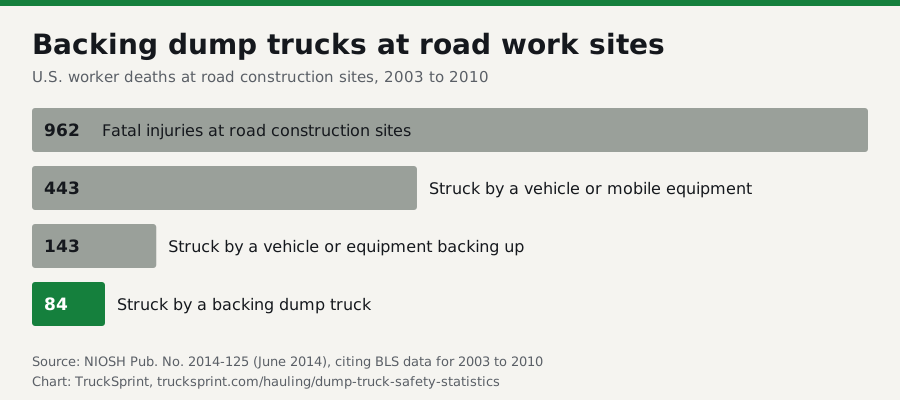
- 962 workers died from injuries at U.S. road construction sites from 2003 to 2010.
- 443 of them were struck by a vehicle or mobile equipment.
- 143 were struck by a vehicle or equipment that was backing up.
- 84 of those were struck by a backing dump truck, more than half.
- 36 worker deaths from backing construction vehicles on roadway sites were investigated by NIOSH and state partners through the FACE program from 1992 to 2009.
Source: NIOSH, Preventing Worker Injuries and Deaths from Backing Construction Vehicles and Equipment at Roadway Construction Worksites, DHHS (NIOSH) Pub. No. 2014-125 (June 2014), citing BLS data 2003-2010 · checked 2026-10
Embed this chart
What these numbers cover: road construction sites only, from BLS data analyzed by NIOSH. They're the most specific public dump truck backover figures we found, but they aren't a current annual count.
Prevention (NIOSH): design the site to minimize backing; back only under a spotter's direction; use cameras or proximity warning systems; keep workers on foot out of truck paths with an internal traffic control plan; require high-visibility clothing; and give the people coordinating trucks two-way radios. OSHA requires a reverse alarm audible above site noise, or a spotter, for any vehicle with an obstructed rear view on a construction site (29 CFR 1926.601(b)(4)).
Truck drivers at work
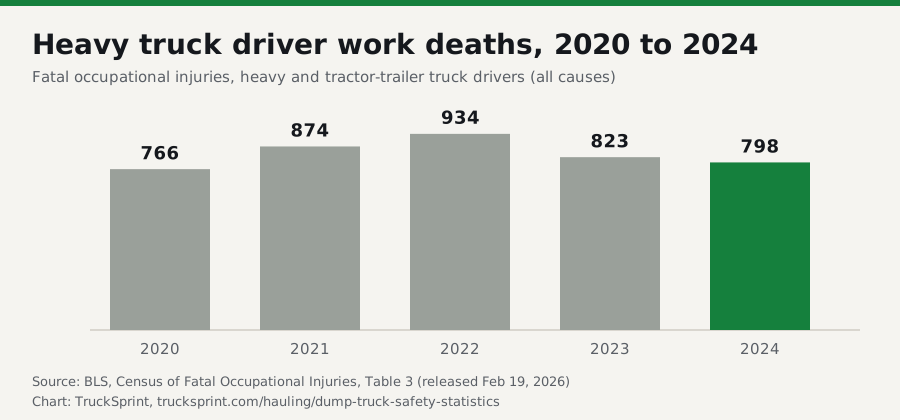
- 798 fatal work injuries among heavy and tractor-trailer truck drivers in 2024, down from 823 in 2023 and 934 in 2022.
- 1,391 deaths in transportation and material moving occupations in 2024, the most of any occupational group, at 12.5 per 100,000 full-time-equivalent workers.
- 1,032 deaths among construction and extraction workers in 2024.
- 38.2% of all U.S. workplace deaths in 2024 were transportation incidents (1,937).
- 1,146 deaths in roadway incidents involving motor vehicles in 2024, down 8.5%.
- 369 pedestrians killed in incidents involving motor vehicles at work in 2024, up 19.0% from 310 in 2023.
- 5,070 total U.S. workplace deaths in 2024, at 3.3 per 100,000 full-time-equivalent workers.
Source: BLS, Census of Fatal Occupational Injuries Summary, 2024 (released Feb 19, 2026), and Table 3 · checked 2026-10
Embed this chart
What these numbers cover: BLS counts all fatal work injuries by occupation and event. Dump truck drivers are included in "heavy and tractor-trailer truck drivers" but aren't separated. The pedestrian figure includes workers on foot struck by vehicles, the backover risk on sites.
Prevention (OSHA, 29 CFR 1926.601(b)): seat belts in all motor vehicles on construction sites; a check at the start of each shift of service brakes, parking brake, emergency brakes, tires, horn, steering, coupling devices and more.
Rollovers and dumping
- We found no current public count of dump truck rollovers specifically. Rollovers sit inside broader categories, such as roadway incidents in BLS data and large-truck crashes in NHTSA data.
- 5% of fatal crashes involving large trucks in 2023 happened in work zones (NHTSA).
Source: NHTSA, Traffic Safety Facts: Large Trucks, 2023 Data (DOT HS 813 717, April 2025) · checked 2026-10
Prevention (OSHA, 29 CFR 1926.601(b)): a permanently attached, lockable support to hold a raised dump body during maintenance or inspection; latches on hoist and dump controls so they can't be tripped by accident; tailgate trip handles arranged so the operator is in the clear when dumping. On the ground: raise the body only on firm, level ground; watch for overhead lines; don't try to shake loose a load that's stuck high in a raised body; and load evenly and only to the legal weight, which our hauling aggregate guide covers.
Highway crashes
- 5,472 people were killed in traffic crashes involving large trucks in 2023, and 70% of them were in other vehicles (NHTSA).
Dump trucks are large trucks in NHTSA's definition (over 10,000 lb GVWR), but NHTSA's summary doesn't break out dump trucks. More context in trucking industry statistics.
What it means for a dump truck owner
- Your biggest risk may be behind the truck. Use a spotter or camera every time you back on a site, and ask about the site's traffic plan before the first load.
- Inspect before every shift, as OSHA requires on construction sites. Our pre-trip inspection checklist prints a daily sheet.
- Treat the raised body as a hazard. Lock the support before anyone goes under it.
- Know your truck. Center of gravity and stability differ a lot between setups; see types of dump trucks.