Dump truck rollover prevention: why raised bodies tip, and a pre-dump checklist
Steve Woods · Truck Dispatcher, TruckSprint
Steve Woods is a truck dispatcher with 9 years of experience in trucking. He reviews every guide we publish. How we research and update guides.
Updated October 2026
Quick answer
Dump trucks tip when a raised body lifts the load's center of gravity until the weight moves outside the wheels. Prevent it by dumping only on firm, level ground with the truck and trailer straight, an evenly loaded body that flows out, no high wind, the seat belt on, and the body lowered at once if material sticks.
Source: TruckSprint stability chart (EXAMPLE geometry); 29 CFR 1926.601 · checked 2026-10
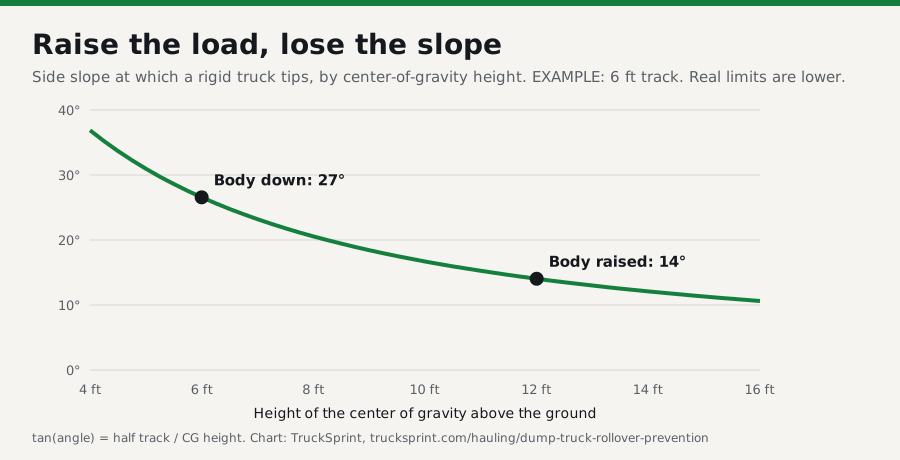
Key finding: in simple static geometry, raising a load's center of gravity from 6 ft to 12 ft cuts the side slope a rigid truck can stand on from about 27 degrees to about 14 degrees (EXAMPLE: 6 ft track). Real trucks tip sooner, because tires and springs lean and loads shift.
I'm Steve Woods, a truck dispatcher at TruckSprint with 9 years in trucking. Tip-overs while dumping are one of the few accidents that happen at walking speed, on the job site, with the truck parked. That's also why they're preventable. This page explains why bodies tip, gives you a chart and a printable checklist, and points to the rules behind them. Updated yearly.
Why raised bodies tip
A truck stays upright as long as its center of gravity sits between the wheels. Lean it, and the center of gravity moves sideways; when it passes the outside wheels, the truck goes over. The higher the center of gravity, the less lean it takes.
A loaded body lowered on the frame keeps the weight low. Raised, the same load sits many feet higher, and an end dump trailer at full lift puts it higher still. The chart shows the geometry for a rigid vehicle:
Embed this chart
Real trucks do worse than the line. Tires squash and springs lean on the low side, which moves the load further out. Material that hangs up high or on one side moves the center of gravity up and over. A gust on a raised body pushes sideways. Any one of these can turn a slope you can't see into a rollover.
Causes and the fix for each
| What tips trucks | Prevention |
|---|---|
| Soft, uneven or sloped ground under the wheels | Dump only on firm, level ground; never on fresh fill edges or a cross slope |
| Truck and trailer out of line | Pull straight before raising; never raise while jackknifed |
| Material stuck high or on one side | Lower the body at once; don't rock the truck or drive forward to shake it loose |
| Load heaped to one side, or frozen in the front | Load evenly; clean the body; handle cold-weather sticking before you raise |
| Wind on a raised body | Don't dump in strong or gusty wind |
| Overload | Load to legal weight; a scale ticket beats a guess |
| Uneven tires or suspension | Check pressures and suspension before dumping; follow the trailer maker's air-suspension instructions |
| Edges and drop-offs | Use a berm or stop at any edge you back up to |
| Overhead lines | Look up before you raise |
On the ground, a lot of this is decided before you arrive: how the loader filled the body, and how the site prepared the dump area. Talk to the site about the dump spot, and refuse a spot that isn't safe.
What a real case looks like
A NIOSH-funded Missouri FACE investigation (report 95MO057) describes a county crew placing fill around a culvert from a truck and dump trailer. Material on one side of the raised trailer stayed in the body while the other side slid out; the trailer became unstable and the truck tipped over with it, killing a worker on the ground. The investigator recommended that employers require workers to alert the operator immediately when material lodges in a dump body during dumping, and that they enforce a safety plan covering heavy equipment hazards.
Source: NIOSH FACE report 95MO057, Missouri (CDC stacks, published Dec 27, 1995) · checked 2026-10
Two lessons hold today: a body that dumps unevenly is an emergency, and people on the ground near a dumping truck are in the fall zone.
What OSHA requires
On construction sites, OSHA's motor vehicle rule at 29 CFR 1926.601(b) sets the hardware rules for dump trucks:
- a permanently attached support that can be locked to keep a raised body from coming down during maintenance or inspection,
- a latch or other device on hoisting and dumping controls to prevent accidental starting or tripping,
- tailgate trip handles arranged so the operator is in the clear when dumping, and
- no backing with an obstructed rear view unless the vehicle has a working reverse alarm or a spotter signals it's safe.
Source: 29 CFR 1926.601, Motor vehicles (eCFR) · checked 2026-10
The hoist, prop and controls themselves are covered in dump truck PTO and hoist.
Free printable pre-dump checklist
Print it, laminate it, and tape one in every cab: download the pre-dump checklist (PDF, 1 page). No sign-up. Here's what it covers:
The ground: firm and level under all wheels; truck and trailer straight; berm or stop at any edge; nothing overhead.
The load: even side to side; tailgate free to swing; nothing frozen or packed in the front; within legal weight.
The truck: hoist, hoses and cylinder not leaking, body prop working; tire pressures even; trailer air suspension handled the way its maker says; seat belt on.
While dumping: no strong wind; if material sticks or flows unevenly, stop and lower the body; people clear of the truck and the spill; body fully down and PTO off before moving off.
Which trucks are most exposed
Any raised body can tip, but the risk grows with the height of the lift. End dump trailers lift the most material the highest; side dumps and belly dumps keep the load low while unloading. That trade-off is part of choosing a trailer; see end dump vs belly dump vs side dump. For the published injury and fatality data that does exist, see dump truck safety statistics. Loading and covering habits are in hauling aggregate, and the daily truck check is in the pre-trip checklist.
Method
The chart uses the rigid-body static stability relation: a vehicle on a side slope tips when tan(angle) equals half its track width divided by its center-of-gravity height. EXAMPLE track 6 ft (half track 3 ft); heights from 4 to 16 ft. It ignores tire and suspension deflection, load shift and wind, all of which lower the real limit, so it shows direction and size of the effect, not a safe slope for any truck. Reviewed every October.
TruckSprint no longer dispatches dump trucks. If you also run a 26 ft box truck, our desk can keep it loaded.
Sources
- 29 CFR 1926.601, Motor vehicles (eCFR)
- NIOSH Fatality Assessment and Control Evaluation, Missouri report 95MO057 (CDC stacks)
- Static stability geometry: our calculation, method above