Aggregate base and other aggregate types: weights per yard and a hauler's chart
Steve Woods · Truck Dispatcher, TruckSprint
Steve Woods is a truck dispatcher with 9 years of experience in trucking. He reviews every guide we publish. How we research and update guides.
Updated October 2026
Quick answer
Aggregate base is a dense-graded mix of crushed stone or gravel with fines, compacted in layers under pavement and slabs. Published factors put base course at 1.25 tons per loose cubic yard (New Mexico) and compacted base at about 2.09 tons per yard (Missouri DOT). Other aggregates range from 0.8 (fill dirt) to 1.62 (pit run) tons per yard.
Source: NM EMNRD conversion factors; Missouri DOT estimate factors · checked 2026-10
Key finding: the same EXAMPLE 13.25-ton legal tri-axle load is just 8.2 cubic yards of pit run gravel but 16.6 cubic yards of fill dirt, using published conversion factors. Material, not body size, decides how many yards you can legally haul.
Aggregate base, crusher run, Class 5, #57: the names change from state to state and yard to yard, and so do the weights people quote. I'm Steve Woods, a truck dispatcher at TruckSprint with 9 years in trucking. This guide sticks to published weights, explains the common types in plain words, and gives you a chart to print for the cab. Updated yearly.
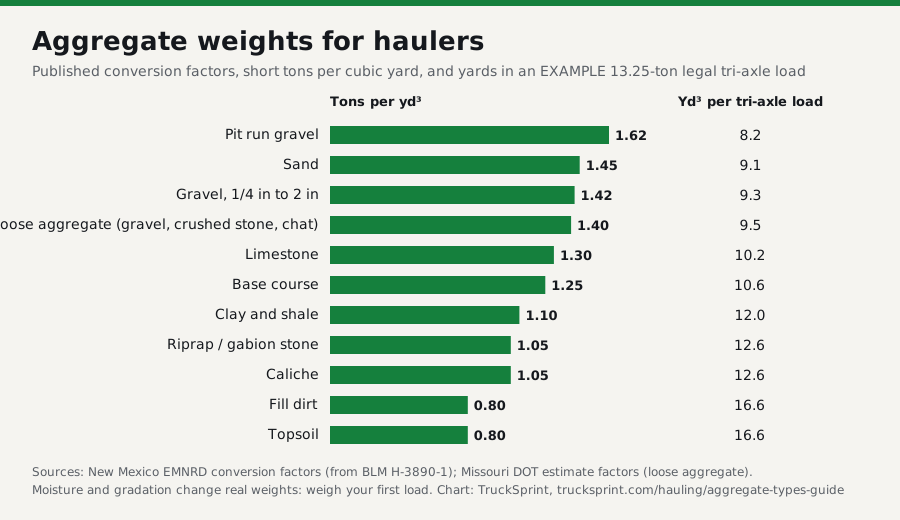
Embed this chart
Download the data: aggregate weights (CSV), with yards per tandem, tri-axle and quad load.
Aggregate types, in plain words
| Type | What it is | Typical use |
|---|---|---|
| Aggregate base (base course) | Crushed stone or gravel with fines, dense-graded | Compacted layer under pavement, slabs, driveways |
| Crusher run | Crushed stone straight from the crusher, fines kept | Driveways, base, pads; packs hard |
| Class 5 | Minnesota DOT's name for a dense-graded aggregate base class (Spec 3138) | Road and driveway base in Minnesota |
| #57 stone | Clean coarse aggregate, size No. 57: 1 in to No. 4 | Concrete, drainage, pipe bedding |
| #67 stone | Clean coarse aggregate, size No. 67: 3/4 in to No. 4 | Concrete, smaller drainage stone |
| Riprap | Large angular stone, sized by class | Erosion control on slopes, ditches, shorelines |
| Pit run | Unprocessed gravel as dug from the pit | Fill, sub-base, haul roads |
| Sand | Fine aggregate | Concrete, bedding, fill |
Source: Oklahoma DOT, Construction Control Directive 19970605 (Feb 15, 2002): coarse aggregate sizes · checked 2026-10
The sizes like No. 57 and No. 67 are standard coarse aggregate sizes used in state DOT specifications; the name tells you the range from the largest to the smallest stone. Base materials like crusher run and Class 5 are defined by each state's gradation table, so a "base" in one state isn't identical to a "base" in the next. Get the spec number on the order when it matters.
Weight per cubic yard: the published numbers
| Material | Short tons per cubic yard | Source |
|---|---|---|
| Pit run gravel | 1.62 | New Mexico EMNRD |
| Sand | 1.45 | New Mexico EMNRD |
| Gravel, 1/4 to 2 in | 1.42 | New Mexico EMNRD |
| Loose aggregate (gravel, crushed stone, chat) | 1.40 | Missouri DOT |
| Limestone | 1.30 | New Mexico EMNRD |
| Base course | 1.25 | New Mexico EMNRD |
| Clay and shale | 1.10 | New Mexico EMNRD |
| Riprap / gabion stone | 1.05 | New Mexico EMNRD |
| Caliche | 1.05 | New Mexico EMNRD |
| Fill dirt | 0.80 | New Mexico EMNRD |
| Topsoil | 0.80 | New Mexico EMNRD |
Source: New Mexico EMNRD, Conversion Factors for Construction Materials and Common Minerals (adapted from BLM H-3890-1) · checked 2026-10
Source: Missouri DOT, Estimate Factors (EPG 450, statewide averages for preliminary estimates) · checked 2026-10
These are planning factors. Wet material weighs more, a dry pile less, and two quarries' "base" can differ. Riprap weighs less per yard than gravel because big stones leave big voids between them, even though each stone is solid rock.
Loose vs compacted: why the numbers jump
A yard in the truck isn't a yard on the ground. Missouri DOT's estimating factor for compacted aggregate base is 0.058 tons per square yard per inch of depth, which works out to about 2.09 tons per cubic yard, against 1.40 for loose aggregate. Its compacted asphalt mixes run from 1.970 to 2.036 tons per cubic yard.
That's why a contractor's "yards in place" and your "yards in the body" never match. Price and ticket by tons from the scale, and let the contractor convert to yards in place.
What it means in the truck
Heavy material reaches the legal limit long before the body is full; light material fills the body first. With EXAMPLE legal payloads from our tri-axle vs quad vs quint guide:
| Material | Tandem, 12 tons | Tri-axle, 13.25 tons | Quad, 15.75 tons |
|---|---|---|---|
| Pit run (1.62) | 7.4 yd³ | 8.2 yd³ | 9.7 yd³ |
| Gravel (1.42) | 8.5 yd³ | 9.3 yd³ | 11.1 yd³ |
| Base course (1.25) | 9.6 yd³ | 10.6 yd³ | 12.6 yd³ |
| Riprap (1.05) | 11.4 yd³ | 12.6 yd³ | 15.0 yd³ |
| Fill dirt (0.80) | 15.0 yd³ | 16.6 yd³ | 19.7 yd³ |
Your legal payload depends on your truck's empty weight and axle spacing; see dump truck capacity for the method.
Hauling notes by type
- Base and crusher run: packs in the body when wet; dump promptly and keep the body clean.
- #57 and other clean stone: flows out easily; a mesh tarp is fine (tarp systems).
- Sand and fines: leaks through worn tailgate seals; check the seal.
- Riprap: hard on the body floor and tailgate; dump with care and inspect for damage.
- Fill and topsoil: light by weight but bulky, and wet clay can stick high in the body; see topsoil vs fill dirt.
The full haul, from loading to tickets, is in hauling aggregate, and national production and price data is in construction aggregate hauling statistics.
Method
Weights are copied from two public tables: New Mexico EMNRD's conversion factors for construction materials (adapted from BLM handbook H-3890-1) and Missouri DOT's estimate factors. Where both list a material, both are shown. Yards per load divide an EXAMPLE legal payload by the factor. Size definitions come from a state DOT document. We re-check the sources every October.
TruckSprint no longer dispatches dump trucks. If you run a small fleet of road trucks too, our desk can keep those loaded.
Sources
- New Mexico EMNRD, Conversion Factors for Construction Materials and Common Minerals
- Missouri DOT, Estimate Factors (EPG 450)
- Oklahoma DOT, Construction Control Directive 19970605 (aggregate sizes)
- Minnesota DOT, Standard Specification 3138 (aggregate base classes)